
Millions of Americans rely on SSI and social security payments each month to meet their basic needs, but understanding the difference between these programs can be confusing. This comprehensive 2026 guide explains everything you need to know about Supplemental Security Income (SSI) and Social Security retirement/disability benefits.
I’ve spent years helping people navigate these programs sitting across the table from seniors who had no idea they were leaving money on the table, or families who assumed SSI and Social Security were just two names for the same thing. They’re not. And that confusion? It costs people real money every single month. Let me break this down for you in plain language.
What Are SSI and Social Security Payments, Really?
SSI and social security payments are two distinct federal assistance programs overseen by the Social Security Administration (SSA), each serving different populations with different requirements.
I always explain it this way to people I work with: one program is about what you’ve earned, and the other is about what you need. That single distinction changes everything about who qualifies, how much you get, and when your money arrives.
Social Security which includes retirement benefits, SSDI (disability), and survivors benefits is essentially a return on the payroll taxes you’ve been contributing your entire working life. The SSA looks at your highest 35 years of earnings, calculates your “average indexed monthly earnings,” and that number determines your monthly check.
SSI (Supplemental Security Income), on the other hand, doesn’t care about your work history at all. It’s a needs-based program. If you’re 65 or older, blind, or disabled and you have very limited income and resources, SSI exists specifically to help you cover the basics. No work history required. Not a single payroll contribution needed.
The Key Differences Nobody Explains Clearly
The major difference between SSI and Social Security payments is that SSI eligibility is based on age or disability plus limited income and resources, whereas Social Security benefits are earned through work history and payroll taxes.
Here’s what that looks like in real life:
Say you worked for 30 years, paid into Social Security the whole time, and then became disabled at 55. You’d likely qualify for SSDI based on your work record. But your neighbor who never worked much maybe they were a full-time caregiver their whole life wouldn’t have those work credits. If they’re disabled or over 65 and have very little income, SSI is their program.
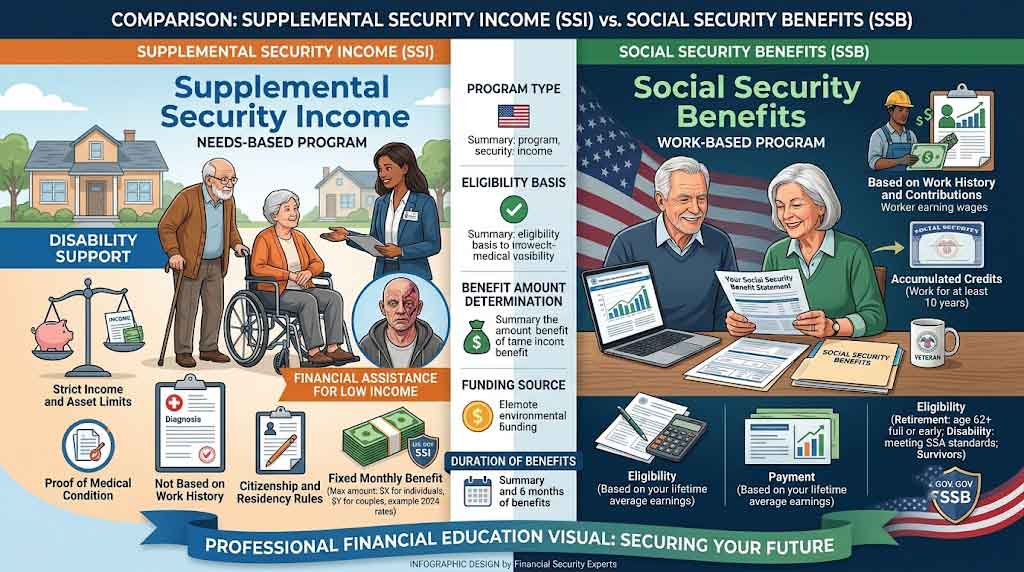
The other big difference is what counts against you. For Social Security, your current income doesn’t reduce your benefit much (there are some rules if you’re under full retirement age and still working, but once you hit full retirement age, earn as much as you want). For SSI, your income and resources are constantly being checked. Have too much money in savings? Your SSI benefit goes down or disappears entirely.
Payment amounts also differ significantly:
| Program | Average Monthly Payment (2024) | With 2025 COLA |
|---|---|---|
| SSI | $698 month | +2.8% ($56 increase) |
| SSDI | $1,537 month | +2.8% |
| Social Security Retirement | $1,900 month | +2.8% |
For 2026, the maximum SSI benefit sits at $994 month for individuals and $1,491 month for couples. These are the federal maximums some states add a small supplement on top of that.
2026 SSI and Social Security Payment Dates
This is the section most people come looking for, and I get it. When you’re budgeting on a fixed income, knowing exactly when your money hits is not just helpful it’s critical.
Here are the official 2026 SSI and Social Security payment dates that millions of Americans depend on:
SSI Payment Schedule 2026:
- December 31, 2025 January 2026 SSI payment (early, due to holiday)
- January 30, 2026
- February 27, 2026
- April 1, 2026 (March payment)
- May 1, 2026 (April payment)
- June 1, 2026 (May payment)
- July 1, 2026
- July 31, 2026 (August payment early due to September 1 being a holiday)
- September 1, 2026
- October 1, 2026
- October 30, 2026 (November payment early)
- December 1, 2026
The rule is simple: SSI is paid on the 1st of the month, or the previous business day if the 1st falls on a weekend or holiday. That’s why you sometimes see payments arrive in late October or late July it’s not an error, it’s the SSA getting ahead of a weekend or federal holiday.
For Social Security Retirement and SSDI, your payment date depends on your birthday:
- Born 1st–10th of the month: paid on the second Wednesday
- Born 11th–20th: paid on the third Wednesday
- Born 21st–31st: paid on the fourth Wednesday
The January 2026 payment was distributed January 2, instead of the usual January 3, and it included the 2.8% COLA increase.
One thing I always tell people: if your payment doesn’t arrive within 3 business days of the scheduled date, that’s when you should call SSA. Don’t panic on the scheduled date itself sometimes direct deposit just takes a little longer to post depending on your bank.
Can You Receive Both SSI and Social Security?
Yes, and more people qualify for this than you’d think.
It’s possible to receive both SSI and Social Security payments if you qualify for SSI based on income and resources, and you are also eligible for Social Security benefits based on work history. This is called receiving “concurrent benefits.”
Roughly 50% of people over 65 who receive SSI benefits also receive some form of Social Security. Here’s the most common scenario: someone worked for years but at low wages, so their Social Security retirement check is small, say $400 or $500 a month. That puts their total income below the SSI threshold, so they can supplement with SSI to bring their monthly total closer to the SSI maximum.
The SSA automatically offsets the amounts. Your Social Security income reduces your SSI dollar for dollar after the first $20, so the programs work together rather than stacking fully. But you’re still better off receiving both than just one.
And no you don’t need a bank account to receive SSI benefits. The SSA offers a prepaid debit card option for direct deposit if you don’t have a traditional bank account. Nobody should be missing out on benefits over something like that.
How to Apply: What You Actually Need

I’ve walked a lot of people through this process, and the applications are far less intimidating once you know what to gather beforehand.
For SSI, you’ll need:
- Photo ID (driver’s license or state ID)
- Your Social Security card
- Recent bank statements
- Pay stubs or other proof of income
- Medical records if applying based on a disability
- Housing information your rent or mortgage payment amount
For Social Security (retirement or SSDI), gather:
- Birth certificate
- Your work history records the SSA needs up to 35 years of earnings
- Marriage certificate if applying for spousal benefits
- Military discharge papers if you served
- Bank account information for direct deposit
Where to apply:
- Online: ssa.gov the my Social Security portal is genuinely user-friendly and the fastest option for most people
- By phone: 1-800-772-1213 (be patient hold times can be long, but the representatives are helpful)
- In person: Your local SSA field office I’d recommend making an appointment online first to avoid long waits
The 2026 COLA Increase: What It Means for Your Check
Starting with January 2026 payments, SSI and Social Security payments beneficiaries saw a 2.8% cost-of-living adjustment (COLA), translating to an average monthly increase of about $56.
Every beneficiary retired workers, SSDI recipients, SSI recipients, survivors received this same 2.8% bump. For SSI recipients, the January 1 payment was distributed December 31, 2025, which is standard when January 1 falls on a holiday, and the COLA increase was included in that payment.
It’s not a huge increase, and I know a lot of people feel it doesn’t keep pace with actual living costs. But it does matter over a full year, that $56/month adds up to $672, and for someone on a fixed income, that’s real money.
Common Questions I Get Asked All the Time
“Is SSI the same as Social Security?”
No. SSI is a needs-based program for low-income individuals, while Social Security benefits are earned through work history and payroll taxes. Different funding sources, different eligibility rules, different payment structures.
“How do I know which one I’m receiving?”
Check your SSA letter it will say either “Supplemental Security Income” or “Social Security” clearly at the top. You can also call SSA at 1-800-772-1213 or log into your account at ssa.gov to see exactly which benefits you’re enrolled in.
“What if my payment is missing?”
Wait three full business days past the scheduled payment date before contacting SSA. Direct deposit timing varies slightly by bank. If it still hasn’t arrived, call SSA directly don’t just wait and hope it shows up.
“Can I get SSI if I’m already receiving Social Security retirement?”
Absolutely, if your income and resources fall below the SSI limits. About half of all SSI recipients over 65 also receive Social Security. Apply for both and let SSA calculate what you’re owed.
Final Thoughts
Understanding the difference between SSI and social security payments is crucial for maximizing your benefits and ensuring you receive the financial assistance you qualify for. Whether you’re applying for SSI based on limited income, Social Security retirement based on work history, or both, this 2026 guide provides all the payment dates, eligibility requirements, and application steps you need.
The biggest mistake I see people make is assuming they don’t qualify, or assuming their situation is too complicated to figure out. Start with ssa.gov, use the benefit eligibility tool, and when in doubt, call the SSA or walk into a field office. These benefits exist for you. Don’t leave them unclaimed.
Have questions about your specific situation? Contact us we’re happy to help you figure out exactly what you qualify for.